
Montana’s Prosperity Depends on Industry, Not Vacation Homes
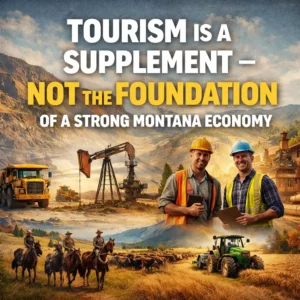 Recently, the Whitehall Ledger published an article by Rep. Llew Jones arguing that Montana's economy has "shifted" from natural resource industries to tourism, service work, and high-end real estate — and that our tax system and future economic vision should shift along with it. In other words, we should accept this new direction and build our future around the economic class moving into Montana, rather than the industries that built it.
I couldn't disagree more!
Montana earned the name "The Treasure State" long before luxury homes and tourism brochures became our calling card. Our prosperity was built on copper, coal, timber, oil, gas, agriculture, and the hard work of the men and women who turned raw resources into real opportunity.
Yet today, some in Helena argue that Montana should lean even further into tourism, seasonal service-sector work, and the spending habits of wealthy newcomers. That approach isn't just misguided — it's risky.
We didn't lose our industry because we outgrew it. We lost it because federal agencies, activist groups, and layers of regulation slowly strangled it. We made it easier to build multimillion-dollar vacation homes than to build sawmills, and we pushed young workers into unstable service jobs while shutting down the very industries that once gave them careers, not just shifts.
Our economy didn't change because Montanans wanted it to. It changed because we allowed it to. It changed because we stopped fighting for our right to work in our own state.
Tourism is a great supplement—but it is not a foundation. It is seasonal, unstable, and vulnerable to economic shocks. We learned this during COVID. When travel stopped, tourism collapsed. Businesses shuttered, workers lost income, and entire communities struggled. And even today, many tourism dollars never stay in Montana—corporate out-of-state ownership is climbing fast.
But the bigger issue is this: a tourism-based economy cannot sustain Montana's families, schools, or infrastructure in the long term. A resource-based economy can.
This is where Llew Jones' argument truly fails. Building Montana's future around ever-higher taxes on wealthy newcomers isn't a strategy — it's a gamble. Wealth tied to second homes and luxury properties is not an industry; it's a preference. Preferences change. Markets shift. Those people can sell tomorrow, and many do whenever a state's tax climate changes or another destination becomes more appealing.
When a state pins its tax base to one narrow, affluent class of property owners, it's not "modernizing the economy" — it's putting all of Montana's eggs in one very fragile basket. That isn't stability. That's volatility.
A sustainable economy is built on tangible production — industries that cannot be outsourced, relocated, or shut down based on a trend. Industries such as mining, drilling, timber, ranching, farming, and manufacturing. These sectors anchor families, support schools, stabilize communities, and generate year-round revenue because they are rooted in the land itself.
Montana's natural resources are blessings, not burdens. God placed abundant mineral, timber, grazing, and energy resources beneath and around us. But instead of stewarding them responsibly and using them to provide prosperity for our people, we've locked them away behind red tape, activist lawsuits, and federal micromanagement.
And when we stop utilizing our resources, we don't "protect" Montana—we weaken it. We turn Montana into a playground for visitors and a vacation haven for the elite, instead of a place where our children and grandchildren can build real lives rooted in this land.
Montana doesn't need to surrender to the "minerals to mansions" narrative. We don't need to accept an economy built on postcards and property speculation. We need to reclaim the industries we allowed to be regulated out of existence and restore a Montana where hardworking families can build real lives rooted in real production.
Tourism may bring cash, but industry brings stability. Industry brings families. Industry builds communities that last.
Montana's future won't be saved by catering to the wealthy — it will be saved by Montanans getting back to work.
Please Consider Supporting My Campaign
Like what you’ve read? I believe Montana deserves honest leadership, greater transparency, and a government that works for the people — not against them. As a candidate for House District 69, I’m committed to cleaning up corruption, defending our freedoms, and putting common-sense solutions first. If you think I’d be a strong voice for Helena, please consider supporting my campaign.